
Biology: 10th Grade 6 Sections34 Lessons6 QuizzesLifetime
Lesson Two: Plant Anatomy and Physiology
🎯 Competencies (Learning Goals)
Dear learner!
By the end, you’ll be able to:
- Identify and describe the structure and function of roots, stems, leaves, flowers, and seeds.
- Explain the mechanisms of water and nutrient transport (xylem & phloem).
- Analyze plant responses to environmental stimuli (tropisms, hormones).
📚 Core Lesson
1. Structure & Function of Plant Parts
Plants are remarkable living systems with specialized structures and sophisticated processes that enable growth, survival, and reproduction. In this lesson, you’ll explore:
- Structure & Function : How roots, stems, leaves, and flowers are uniquely designed for their roles.
Fig. External structure of angiosperm plants.
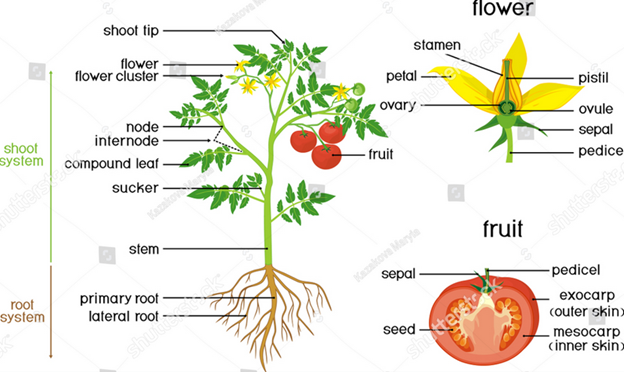
Fig. Plant leaf internal structure
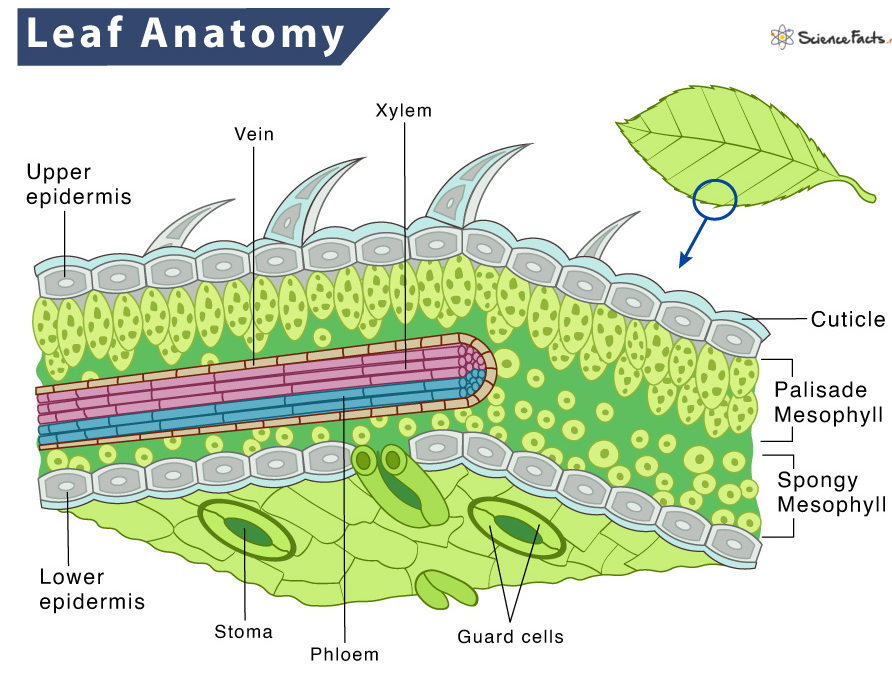
A.. Internal Structure of Plant leaf
Key Layers:
- Upper Epidermis:
- Waxy cuticle prevents water loss
- Transparent to allow light penetration
- Palisade Mesophyll:
- Tightly packed, elongated cells
- Primary site of photosynthesis (contains chloroplasts)
- Spongy Mesophyll:
- Loosely arranged cells with air spaces
- Facilitates gas exchange (CO₂/O₂)
- Lower Epidermis:
- Contains stomata (guard cells regulate opening)
- Allows transpiration and gas exchange
- Vascular Bundles (Veins):
- Xylem: Transports water/minerals upward
- Phloem: Transports sugars downward
B . Internal Structure of Plant Stem
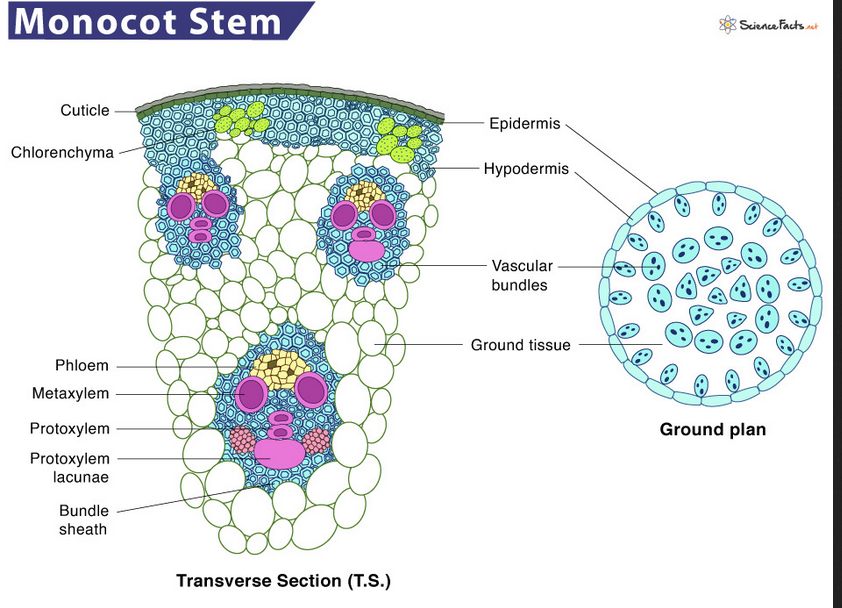
Fig. Stem internal Structure (Dicot Example)
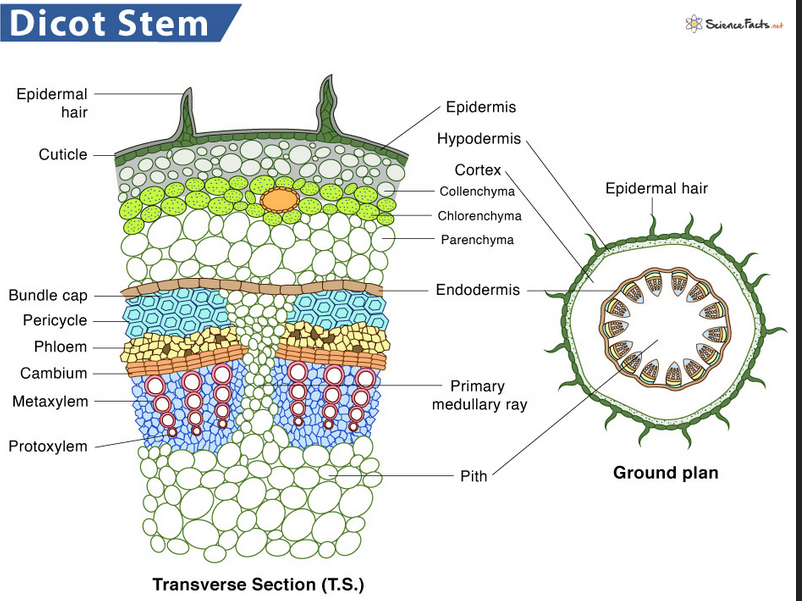
Fig. Stem internal Structure (Dicot Example)
Key Tissues:
- Epidermis:
- Protective outer layer with cuticle
- Cortex:
- Stores starch (parenchyma cells)
- Vascular Bundles (arranged in a ring):
- Xylem: Inner side, transports water
- Phloem: Outer side, transports sugars
- Cambium: Between xylem/phloem; produces new vascular tissue
- Pith:
- Central region for storage (parenchyma)
- Transport Systems : The “plumbing” of plants—how water, nutrients, and sugars move through xylem and phloem.
- Plant Responses : The hidden intelligence of plants—how they sense and react to light, gravity, and other stimuli.
- Epidermis & Root Hairs:
- Absorbs water/minerals (↑ surface area)
- Cortex:
- Stores starch; transports water to vascular cylinder
- Endodermis:
- Casparian strip regulates water/nutrient entry
- Vascular Cylinder (Stele):
- Xylem: Star-shaped center; transports water upward
- Phloem: Between xylem arms; transports sugars
- Pericycle:
C . Internal Structure of Plant Root
Fig. Root Structure (monocot root vs dicot rot)
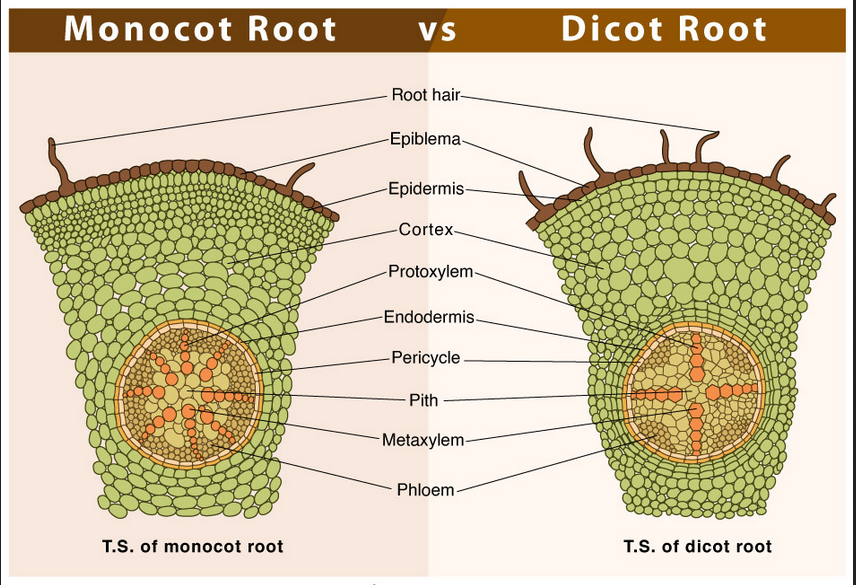
Key Zones:
- Epidermis & Root Hairs:
- Absorbs water/minerals (↑ surface area)
- Cortex:
- Stores starch; transports water to vascular cylinder
- Endodermis:
- Casparian strip regulates water/nutrient entry
- Vascular Cylinder (Stele):
- Xylem: Star-shaped center; transports water upward
- Phloem: Between xylem arms; transports sugars
- Pericycle:
- Produces lateral roots
Comparative Summary Table: Leaf vs. Stem vs. Root
| Feature | Leaf | Stem | Root |
|---|---|---|---|
| Epidermis | Waxy cuticle, stomata | Waxy cuticle | Root hairs present |
| Vascular | Veins (xylem/phloem) | Bundles in ring | Central vascular cylinder |
| Function | Photosynthesis | Support & transport | Absorption & anchorage |
Key Adaptations:
- Leaves: Thin structure maximizes light absorption
- Stems: Lignin in xylem provides structural support
- Roots: Root hairs increase absorption efficiency
Comparative Table:
| Part | Specialized Cells/Tissues | Function | Adaptations |
|---|---|---|---|
| Roots | Root hairs, endodermis | Water/mineral uptake | Mycorrhizal partnerships |
| Stems | Vascular bundles | Nutrient superhighway | Woody vs. herbaceous |
| Leaves | Palisade mesophyll | Light capture | Waxy cuticle prevents drying |
🔍 Brainstorming:
- Why do desert plants have such deep roots?
- How might leaf shape differ between rainforest and tundra plants?
2. Transport in Plants
Process Comparison:
| Feature | Xylem Transport | Phloem Transport |
|---|---|---|
| Driver | Transpiration pull | Pressure-flow |
| Direction | Unidirectional (↑) | Bidirectional (↕) |
| Energy | Passive | Active (ATP-requiring) |
🔍 Brainstorming:
- What would happen if you removed all the leaves from a plant?
- Why does girdling (removing bark) kill trees?
PLANT TRANSPORT SYSTEM  summary
[Soil Water]
│
▼ (Osmosis - Passive absorption)
[Root Hairs]
│
▼ (Xylem Transport ↑ Water + Minerals)
[Stem]
│
▼ (Transpiration Pull - Evaporation)
[Leaves]
╱ ╲
(Phloem ↙ Sugars+Hormones ↘) (Phloem → Fruits/Flowers)
[Roots]
3. Plant Responses
Plants respond to environmental stimuli through tropisms (directional growth) and hormonal actions:
1. Tropisms
- Phototropism: Growth toward light (auxin-mediated)
- Gravitropism: Roots grow downward, stems upward
- Thigmotropism: Response to touch (e.g., vine coiling)
2. Key Hormones & Actions
| Hormone | Role |
|---|---|
| Auxins | Cell elongation, apical dominance |
| Gibberellins | Stem growth, seed germination |
| Abscisic Acid | Closes stomata under stress |
| Ethylene | Fruit ripening, leaf shedding |
Summary on plants hormones functions
PLANT HORMONES & THEIR ACTIONS
━━━━━━━━━━━━━━━━━━━━━━━━━━━━━

        [Auxins]
         │
         ├─ Stimulates stem growth
         ├─ Causes phototropism (bending toward light)
         └─ Promotes root formation
              │
              ▼
        [Root Development]

        [Gibberellins]
         │
         ├─ Breaks seed dormancy
         ├─ Stimulates fruit growth
         └─ Causes stem elongation
              │
              ▼
        [Taller Plants]

        [Cytokinins]
         │
         ├─ Promotes cell division
         ├─ Delays leaf aging
         └─ Works with auxins
              │
              ▼
        [Balanced Growth]

        [Abscisic Acid]
         │
         ├─ Closes stomata
         ├─ Maintains seed dormancy
         └─ Responds to stress
              │
              ▼
        [Drought Survival]

        [Ethylene]
         │
         ├─ Ripens fruits
         ├─ Causes leaf fall
         └─ Promotes flower aging
              │
              ▼
        [Fruit Harvest Time]

ARROWS SHOW PRIMARY EFFECTS:
 → Stimulation
 ┤ Inhibition
3. Nastic Movements
- Definition:
Nastic movements are non-directional responses to environmental stimuli (light, touch, temperature) that occur independent of the stimulus direction. Unlike tropisms, the movement is not toward or away from the stimulus.
Types & Examples
Thigmonasty (Touch Response)
Example: Venus flytrap snaps shut when touched by prey.
Mechanism: Rapid water loss in cells triggers movement.
Photonasty (Light Response)
Example: Flowers of tulips/open in light and close in darkness.
Mechanism: Changes in cell turgor pressure.
Thermonasty (Temperature Response)
Example: Crocus flowers open in warmth and close in cold.
Nyctinasty (Day/Night Rhythm)
Example: Mimosa pudica leaves fold at night.
Mechanism: Controlled by circadian rhythms and turgor changes.Rapid, non-directional responses (e.g., Venus flytrap snapping).
Plants adapt dynamically to light, gravity, touch, and stress through these mechanisms.
Example: Sunflowers track the sun (heliotropism).
Activity
Instructions:
Click on correct circle choice, If you miss go back and click on try until you get correct.
MCQs: Choose the best answer. Some questions may have multiple plausible options, but only one is most accurate.
[h5p id=”754″]
🔍 Brainstorming:
- Why do sunflowers track the sun across the sky?
- How could you experimentally prove auxin causes phototropism?
💡 Critical Thinking Challenges
- Design Challenge: Create a plant ideal for Mars colonization – which structures would you enhance?
- Data Analysis: Interpret graphs showing transpiration rates under different humidity levels
- Ethics Debate: Should plants have rights since they respond to stimuli?
🧩 Interactive Activities
Instruction: fill in the blank space
Click “Check” to verify your answer.
Read each question carefully.
Type the correct answer in the blank space.
Ensure spelling is accurate (case-insensitive unless specified).
[h5p id=”752″]
❓ Assessment
Read each question carefully . For True/False questions, choose whether the statement is correct or incorrect. For Multiple Choice questions, pick the best answer from the given options. For Fill in the Blank questions, type the missing word(s) to complete the statement accurately. These questions will test your understanding of plant response, including structure of plants part, and their anatomy functions. Good luck!
[h5p id=”767″]
✅ Checklist
Instruction:
Read the competency statements and click those you have mastered. If you achieve in all competencies, click the Complete button below to go to the next section. If you get one or more competency statements wrong, go back to the lesson and revise the content before you go to the next section.
[h5p id=”769″]