
Citizenship: 8th Grade 11 Sections46 Lessons365 Days
1.1 The concept of virtue ethics
Ethics and Virtue Ethics
Citizenship Education Grade 8
Lesson Competencies
At the end of this section, you will be able to:
Explain what virtue and virtue ethics is.
Define what Ethics is.
Differentiate virtue characters from vices.
Describe the relationship between Ethics and virtue.
Analyse steps for ethical decision making.
Key Terms
Ethics
The study of what is right and wrong to do in daily life and the creation of reasonable standards for decision making.
Virtue Ethics
A branch of ethics emphasizing an individual’s character and virtues rather than just rules or consequences.
Virtue
Specific character traits (habits) that make a person good, such as honesty and courage.
Vice
Bad habits or character traits that stand in opposition to virtues, such as dishonesty or selfishness.
Video Lesson
Core Lesson: Developing Good Character
Introduction
Dear learners,
Have you ever found a lost item, like a wallet or a phone? What went through your mind? Did you think about keeping it, or finding the owner? This moment of hesitation and choice is where Ethics comes into play. Today, we will explore how building a good character—Virtue Ethics—prepares us to make the right choices naturally.
1. Understanding Virtue Ethics
Virtue ethics is concerned with the development of one’s character. It believes that a community composed of people of good character acts as a good community.
While some ethical theories focus on rules (don’t steal) or consequences (don’t get caught), Virtue Ethics asks: “What would a virtuous person do?” It assumes that moral virtue is acquired through practice and imitation, just like learning a musical instrument.
2. Virtues vs. Vices
A Virtue is a trait that makes a person good. A Vice is a bad habit, often the polar opposite of a virtue.
| Virtues (Good Character) | Vices (Bad Character) |
|---|---|
| Honesty | Dishonesty |
| Courage | Cowardice |
| Generosity | Selfishness |
| Justice | Injustice |
Case Study: The Fox in The Well
A fox fell into a well. The water was shallow, so he wasn’t drowning, but he couldn’t get out.
“Help! Help!” cried the fox.
A wolf passed by and looked down. “Who is down there?”
“It’s me,” exclaimed the fox. “Please help me!”
The wolf started asking questions: “How did you get down there? Is the water deep? I pity you! You have a cold!”
“Please don’t talk to me,” the fox cried. “I require assistance. Get me out first, and then you can pity me.”
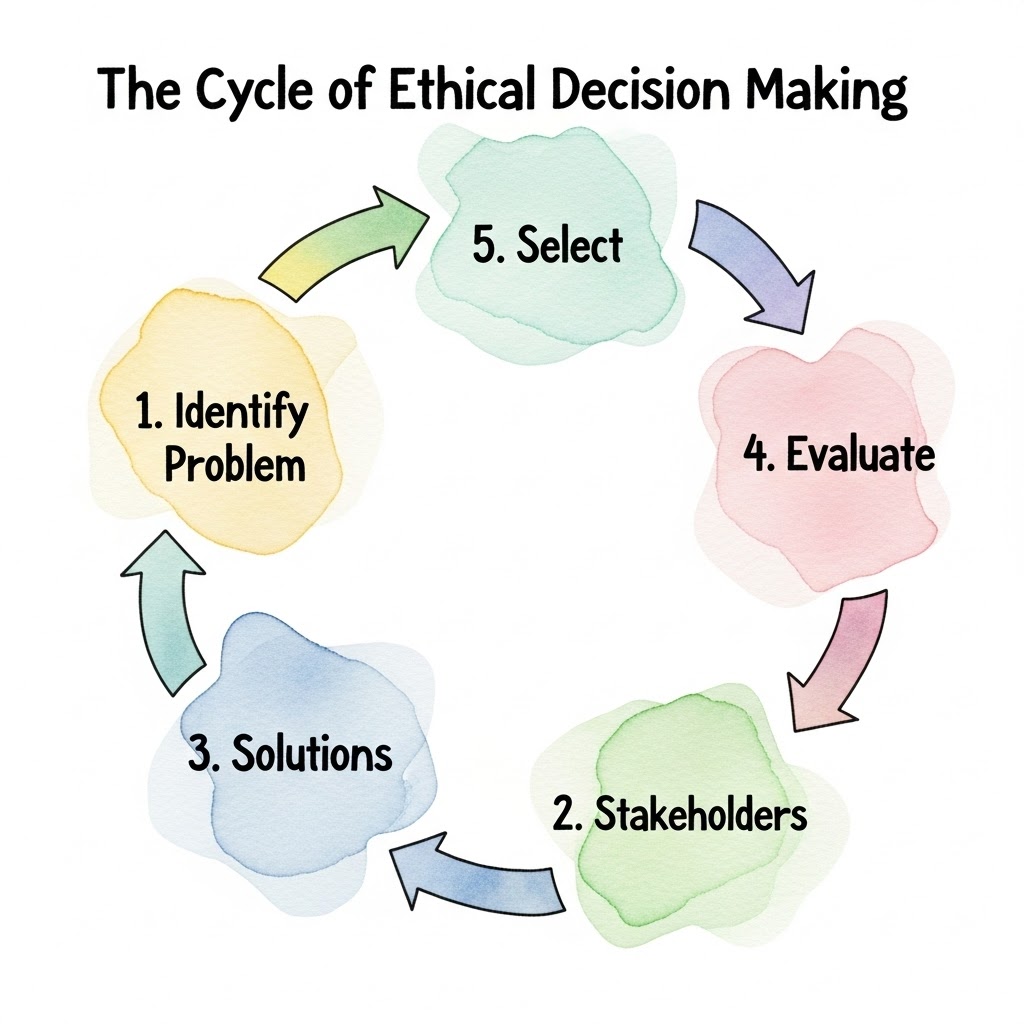
3. Steps in Ethical Decision Making
When facing a moral problem, use these 5 steps:
- Identify the problem: Understand what is wrong through research.
- Identify stakeholders: Who will be affected by the decision?
- Find solutions: Brainstorm possible actions.
- Evaluate solutions: Weigh the strengths and weaknesses.
- Select and justify: Choose the best option that solves the dilemma.
Interactive Lab: Character Builder
Game
Instructions: Move your basket left and right to catch the Virtues (good habits) and build your character. Avoid catching the Vices (bad habits)! Use the Left/Right arrow keys or Touch/Drag on the game screen.
Catch the Virtues!
Activity 1: Understanding Concepts
Loading…
Activity 2: Virtues vs. Vices
Drag the character traits to the correct category (Virtue or Vice).
Character Traits
Virtues (Good)
Vices (Bad)
Activity 3: Mixed Challenge
Loading…
Lesson Summary
Ethics is the study of right and wrong, guiding us to create standards for our behavior in society.
Virtue Ethics focuses on the person’s character rather than just rules. It asks “What would a good person do?”
Virtues are good habits (Honesty, Courage) that help the community, while Vices are bad habits (Dishonesty, Cowardice).
Ethical Decision Making involves 5 steps: Identifying the problem, stakeholders, solutions, evaluating options, and selecting/justifying the best one.