
Social Studies: 8th grade 11 Sections44 Lessons365 Days
1.1 Internal or Tectonic Forces and Resultant Landforms
Internal or Tectonic Forces and Resultant Landforms
Social Studies Eighth Grade
Lesson Competencies
At the end of this lesson, you will be able to:
Explain the concepts of folding and faulting as internal earth forces.
Describe the formation of fold mountains, block mountains, and rift valleys.
Define volcanism and identify different types of volcanoes.
List the advantages and disadvantages of volcanic eruptions.
Explain what an earthquake is and describe its major effects.
Key Terms
Folding
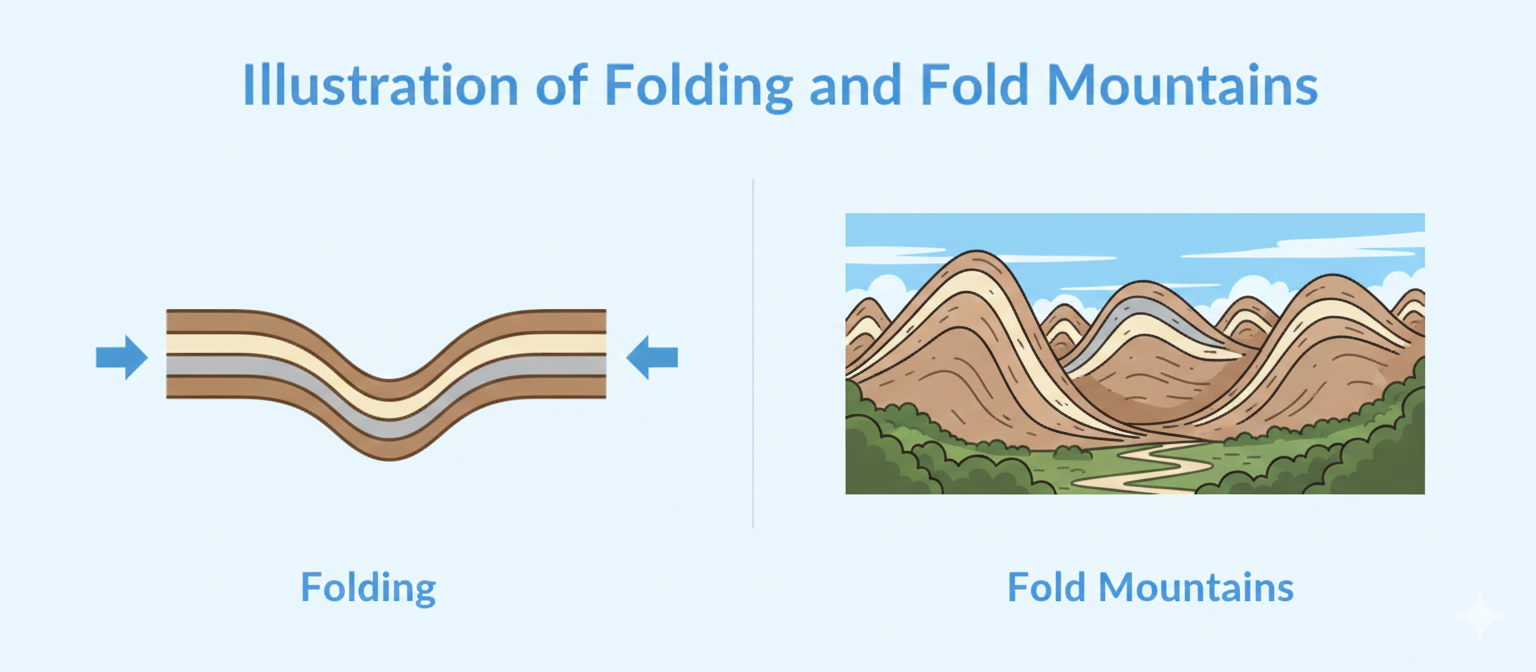
The bending of rock layers due to compressional forces, creating wave-like patterns.
Faulting
The fracturing and displacement of rock along a crack (a fault) caused by tensional or compressional forces.
Rift Valley
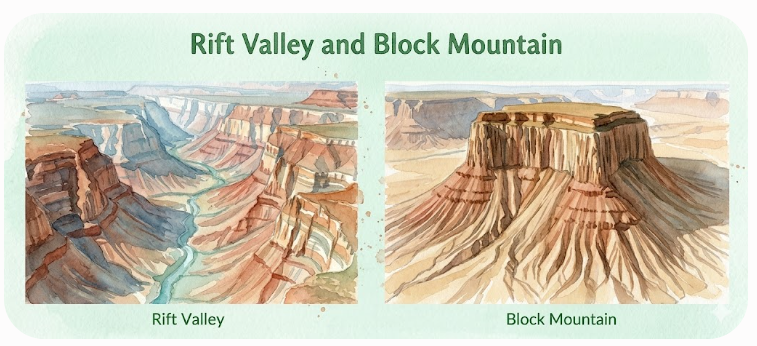
A large, elongated valley formed by the sinking of a block of land between two parallel faults.
Block Mountain (Horst)
A block of land pushed upwards between two parallel faults.
Volcanism
The process where molten rock (magma), ash, and gases escape from below the Earth’s surface onto the crust.
Earthquake
A sudden and violent shaking of the ground, caused by movements within the Earth’s crust or volcanic action.
Video Lesson
Core Lesson: Forces Shaping Our World
Introduction
Dear learners,
Have you ever looked at a tall mountain or a deep valley and wondered how it got there? The surface of our planet, the Earth’s crust, is not static. It is constantly moving and changing, shaped by powerful forces from deep within the Earth. These are called internal or tectonic forces. Today, we will explore these incredible forces and the amazing landforms they create, including many found right here in Ethiopia!
1. Folding and Fold Mountains
Imagine pushing the edges of a rug together. It wrinkles and bunches up in the middle. This is similar to folding! When two of the Earth’s tectonic plates collide, the immense pressure causes the layers of rock to bend and fold. The upward folds are called anticlines, and the downward folds are called synclines. Over millions of years, this process creates massive mountain ranges called Fold Mountains. The Semien Mountains in Ethiopia are great examples of mountains formed through such complex processes.
2. Faulting: Creating Valleys and Mountains
Sometimes, instead of bending, the rocks under stress will break. This crack in the Earth’s crust is called a fault. The land on either side of the fault then moves. This process is called faulting.
- Rift Valleys: When the crust is pulled apart (tensional force), a large block of land can drop down between two parallel faults. This creates a vast, long valley called a Rift Valley. The most famous example on Earth is the Great East African Rift Valley, which passes right through Ethiopia!
- Block (Horst) Mountains: When the crust is compressed, a block of land can be pushed upward between two faults. This uplifted block is a Block Mountain, or a Horst.
3. Volcanism: Fire from Within
Volcanism is the eruption of molten rock, called magma, onto the Earth’s surface. When magma reaches the surface, it is called lava. Volcanoes are cone-shaped mountains or hills built up by repeated eruptions of lava, ash, and rock fragments.
Advantages of Volcanic Eruptions
- Creates very fertile soil for farming.
- Source of geothermal energy.
- Formation of valuable mineral deposits.
- Creates new land and scenic landscapes.
Disadvantages of Volcanic Eruptions
- Destruction of property, homes, and farms.
- Loss of human and animal life.
- Ash clouds can disrupt air travel.
- Can cause climate changes.
4. Earthquakes: The Shaking Earth
An Earthquake is a sudden shaking of the Earth’s surface. They are usually caused by the abrupt movement of rock along a fault line. The point deep within the Earth where the earthquake begins is called the focus, and the point directly above it on the surface is the epicenter.
Effects of Earthquakes
Earthquakes can be extremely destructive, causing buildings to collapse, triggering landslides, and even creating giant ocean waves called tsunamis if the earthquake occurs under the sea.
Interactive Lab: Tectonic Simulator
Experiment with the tectonic forces of tension and compression to see how they shape the Earth’s crust into the landforms you just read about.
Click a button above to apply forces to the crust!
Activity 1: Check Your Knowledge
Select the best answer for each question.
Activity 2: True or False?
Read the statements and decide if they are true or false.
Activity 3: Match the Landform
Drag the landform to the force that creates it.
Landforms
Forming Forces / Processes
Compression Force
Tensional Force
Volcanism
Lesson Summary
The Earth’s crust is shaped by internal forces like compression and tension.
Folding (bending of rock) creates Fold Mountains.
Faulting (breaking of rock) creates Rift Valleys when land sinks and Block Mountains when land is pushed up.
Volcanism is the eruption of magma, which can form fertile soil but is also highly destructive.
Earthquakes are caused by sudden movements along faults and can cause widespread damage.
Final Assessment
Test your understanding of the entire lesson.
Competency Checklist
Check off the skills you have learned in this lesson.