
History 10th Grade 13 Sections53 Lessons365 Days
1.3 Unification of Germany
Unification of Germany
History Grade 10
Lesson Competencies
At the end of the lesson you will be able to:
Explain the fragmentation of Germany before unification.
Identify the role of Otto von Bismarck in the unification process.
Analyze the policy of Blood and Iron.
Describe the major wars that led to the creation of the German Empire.
Compare the German unification process with Ethiopian historical centralization efforts.
Key Terms
Confederation
A loose organization of independent states. Before unification, Germany was a confederation of 39 states.
Zollverein
A German customs union founded in 1834 that eliminated tariffs between German states, fostering economic unity.
Blood and Iron
Bismarck’s policy stating that great questions of the day would be decided by military power and warfare, not speeches.
Realpolitik
“Realistic politics” based on the needs of the state and practical power, rather than moral or ideological principles.
Video Lesson
Watch this summary video on the German Unification process.
Core Lesson: Forging an Empire
Introduction
Dear learners,
Imagine Ethiopia during the Zemene Mesafint (Era of Princes). The country was divided into various regions ruled by independent warlords. To become a strong, modern nation, visionary leaders like Emperor Tewodros II recognized the need to bring these fragmented regions together under one central authority.
In the 19th century, Europe had a similar situation. There was no single country called “Germany.” Instead, there was the German Confederation, a collection of 39 independent states sharing a common language and culture, but lacking political unity. The two most powerful states competing for influence were Austria and Prussia.
The Architect: Otto von Bismarck
In 1862, King Wilhelm I of Prussia appointed a brilliant and ruthless statesman named Otto von Bismarck as his Chancellor (Prime Minister). Bismarck was a master of Realpolitik. He believed that unity would not come through diplomacy or democratic voting, but through strength.
“The great questions of the day will not be settled by means of speeches and majority decisions… but by Blood and Iron.” — Otto von Bismarck
The Steps to Unification
Bismarck systematically executed his plan through three major, carefully calculated wars to isolate enemies and unite the German states under Prussian leadership:
1. The Danish War (1864)
Prussia allied with Austria to seize the provinces of Schleswig and Holstein from Denmark. This tested the Prussian military and set up the next conflict.
2. Austro-Prussian War (1866)
Bismarck turned on Austria. Prussia’s modernized army defeated Austria in just seven weeks, removing Austrian influence from German affairs.
3. Franco-Prussian War (1870-71)
Bismarck provoked a war with France to frighten the independent southern German states into joining Prussia. The crushing victory united all of Germany.
Birth of the Second Reich
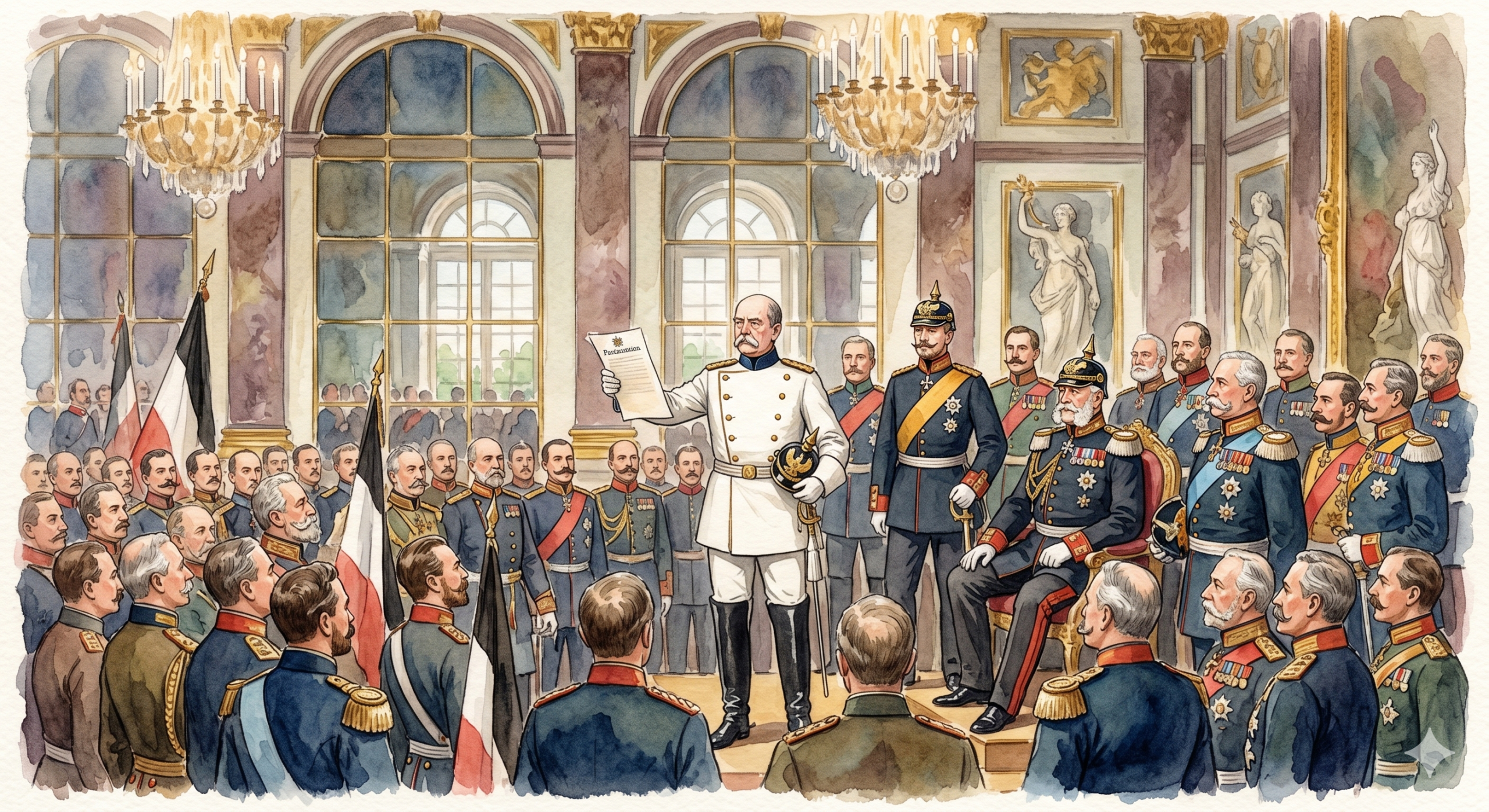
On January 18, 1871, in the Hall of Mirrors at the Palace of Versailles in defeated France, King Wilhelm I of Prussia was crowned Kaiser (Emperor) of a newly united German Empire. This shifted the balance of power in Europe entirely, much like how the unification under Emperor Menelik II created a formidable Ethiopian state capable of defending its sovereignty.
Historical Illustration
Timeline Game: Build the Empire
How to play: Tap an event to select it, then tap the correct historical year box to place it. Alternatively, drag and drop the events to the correct dates.
Historical Events
Timeline (Years)
Activity 1: Knowledge Check (MCQ)
Activity 2: Fact or Fiction
Activity 3: Mixed Challenge
Lesson Summary
Before 1871, Germany was a fragmented confederation of 39 states.
Otto von Bismarck, the Prussian Chancellor, led the unification through a strategy known as Realpolitik.
Bismarck’s “Blood and Iron” policy utilized war and industrial strength rather than diplomacy to achieve goals.
Three major wars (Danish, Austro-Prussian, and Franco-Prussian) resulted in the defeat of Prussia’s rivals and the unification of the German states.
Similar to Ethiopian emperors uniting regional factions into a strong central state, the German Empire was proclaimed in 1871 under Kaiser Wilhelm I.
Final Assessment
Competency Checklist
Self-assess your learning. Check the boxes if you feel confident in these areas: