
Mathematics: 11th Grade 12 Sections64 Lessons365 Days
1.2. Inverse of a Relation and Their Graphs
Mathematics 11th Grade
Lesson Competencies
At the end of this lesson, you will be able to:
Define the inverse of a relation.
Determine the domain and range of an inverse relation.
Find the equation of an inverse relation.
Sketch the graph of an inverse relation.
Understand the relationship between the graph of a relation and its inverse.
Key Terms
Relation
A set of ordered pairs, often represented by an equation, a graph, or a list of pairs \((x, y)\).
Inverse of a Relation (\(R^{-1}\))
A new relation formed by interchanging the first and second components of each ordered pair in the original relation.
Domain
The set of all possible first components (x-values) of the ordered pairs in a relation.
Range
The set of all possible second components (y-values) of the ordered pairs in a relation.
Video Lesson
Core Lesson: Unlocking the Inverse
Dear learners,
Have you ever thought about reversing a process? Like putting on your shoes, the reverse process is taking them off. In mathematics, we can also “reverse” relations. This process of reversal gives us something called the inverse of a relation. It’s a fundamental concept that helps us understand mathematical relationships from a new perspective.
1. Definition of an Inverse Relation
The inverse of a relation is found by simply swapping the x- and y-coordinates in each ordered pair of the relation. If a relation is denoted by \(R\), its inverse is denoted by \(R^{-1}\).
In set notation, if a relation \(R\) is a set of ordered pairs \((x, y)\), then its inverse \(R^{-1}\) is the set of ordered pairs \((y, x)\).
\(R^{-1} = \{ (y, x) \mid (x, y) \in R \}\)
Example 1: A Finite Relation
Let relation \(R = \{ (1, 2), (3, 4), (5, 6) \}\).
To find the inverse, we swap the components of each pair:
The inverse is \(R^{-1} = \{ (2, 1), (4, 3), (6, 5) \}\).
Example 2: A Relation with Repeated Elements
Let relation \(S = \{ (1, 5), (2, 5), (3, 6) \}\).
Even if a y-value is repeated, the process is the same. Swap each pair:
The inverse is \(S^{-1} = \{ (5, 1), (5, 2), (6, 3) \}\).
2. Domain and Range of an Inverse Relation
A beautiful and simple property exists between the domain and range of a relation and its inverse. The roles are swapped!
- The domain of \(R\) is the range of \(R^{-1}\).
- The range of \(R\) is the domain of \(R^{-1}\).
From Example 1:
For \(R = \{ (1, 2), (3, 4), (5, 6) \}\):
Domain of \(R = \{1, 3, 5\}\). This is the Range of \(R^{-1}\).
Range of \(R = \{2, 4, 6\}\). This is the Domain of \(R^{-1}\).
Example 3: Domain and Range from an Equation
Consider the relation \(R\) given by the equation \(y = x^2\).
- Domain of \(R\): We can square any real number, so the domain is \((-\infty, \infty)\).
- Range of \(R\): The square of any real number is non-negative, so the range is \([0, \infty)\).
Now for the inverse, \(R^{-1}\):
- Domain of \(R^{-1}\) = Range of \(R\) = \([0, \infty)\).
- Range of \(R^{-1}\) = Domain of \(R\) = \((-\infty, \infty)\).
3. Graphs of Inverse Relations
The most fascinating part is how the graphs are related. The graph of \(R^{-1}\) is a reflection of the graph of \(R\) across the line \(y = x\).
Imagine placing a mirror on the line \(y = x\). The reflection you see of the original graph is the graph of its inverse.
Example 4: Visualizing the Reflection
If the point \(P(4, 1)\) is on a graph, its inverse point is \(Q(1, 4)\). Notice how they are perfectly reflected across the line \(y=x\).
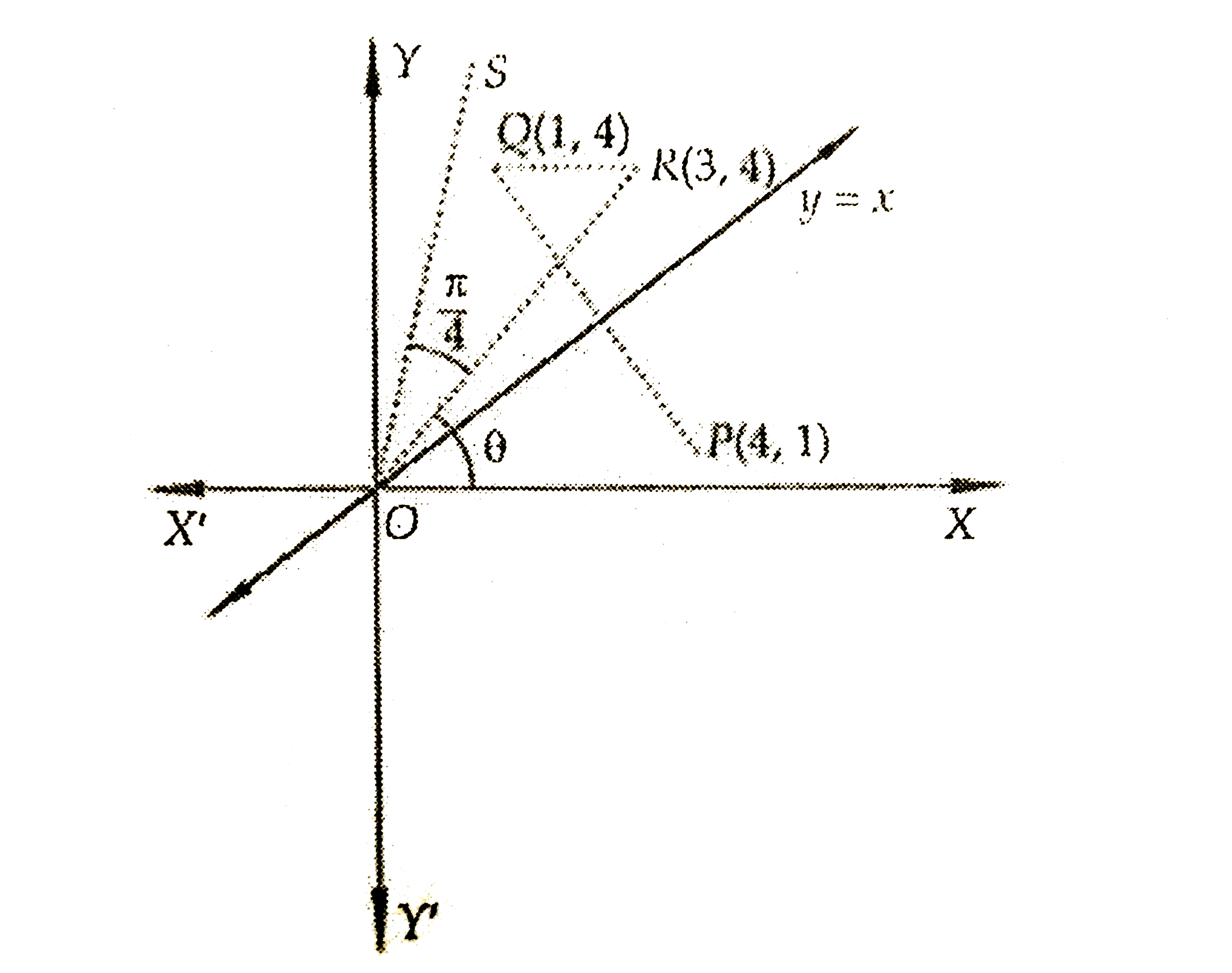
Examples & Illustrations
Finding the Equation of an Inverse
To find the equation of an inverse relation, follow these steps:
- Start with the original equation (e.g., \(y = 2x + 3\)).
- Swap the variables \(x\) and \(y\). (e.g., \(x = 2y + 3\)).
- Solve the new equation for \(y\). This new equation is the inverse.
Example 2:
Find the inverse of the relation \(y = 2x + 3\).
1. Swap \(x\) and \(y\): \(x = 2y + 3\)
2. Solve for \(y\):
\(x – 3 = 2y\)
\(\frac{x – 3}{2} = y\)
So, the inverse relation is \(y = \frac{1}{2}x – \frac{3}{2}\).
Graphing Inverses – Virtual Lab
Instructions:
- Drag the control points on the **Original Function (Blue)** and observe the immediate reflection on the **Inverse Function (Red)**.
- The reflection occurs across the dotted **line of symmetry $y=x$**.
- Check the table below to see the coordinate relationship: **$(a, b)$ becomes $(b, a)$**.
Function Type Presets
Display Options
Drag a point to see coordinate information here.
Activity 1: Multiple Choice Quiz
1. If \(R = \{ (a, b), (c, d) \}\), what is its inverse \(R^{-1}\)?
2. The graph of an inverse relation is the reflection of the original graph across which line?
3. If the domain of a relation \(R\) is \(\{1, 2, 3\}\), what is the range of its inverse \(R^{-1}\)?
4. What is the first step to find the equation of an inverse relation?
5. If the point \((5, -2)\) is on the graph of a relation, which point must be on the graph of its inverse?
Activity 2: True or False
1. The inverse of \(R = \{ (1, 1), (2, 2) \}\) is \(R^{-1} = \{ (-1, -1), (-2, -2) \}\).
2. If a relation contains the origin \((0, 0)\), its inverse also contains the origin.
3. The range of a relation is always the same as the range of its inverse.
4. The inverse of \(y = x\) is \(y = -x\).
5. Every point on the graph of an inverse relation is the same distance from the line \(y = x\) as its corresponding point on the original graph.
Activity 3: Fill in the Blanks
1. If \(R = \{ (8, 3) \}\), then \(R^{-1} = \{ (3, \)\) \}.
2. The domain of \(R^{-1}\) is the same as the of R.
3. The graphs of a relation and its inverse are symmetric with respect to the line \(y = \).
4. To find the inverse of \(y = x - 5\), we first swap x and y to get \(x = y - \).
5. If the range of \(R\) is \(\mathbb{R}\) (all real numbers), then the domain of \(R^{-1}\) is .
Lesson Summary
An inverse relation, \(R^{-1}\), is formed by swapping the \(x\) and \(y\) components of each ordered pair in the original relation \(R\).
The domain of \(R\) becomes the range of \(R^{-1}\), and the range of \(R\) becomes the domain of \(R^{-1}\).
To find the equation of an inverse, swap \(x\) and \(y\) in the original equation and then solve for the new \(y\).
The graph of an inverse relation is a mirror image (reflection) of the original relation's graph across the line \(y = x\).
Final Assessment
1. What is the inverse of the relation \(y = x^2\)?
2. True or False: If \(R\) is a relation, then \((R^{-1})^{-1} = R\).
3. The domain of \(R = \{ (x, y) \mid y = \sqrt{x-2} \}\) is \([2, \infty)\). What is the range of \(R^{-1}\)?
4. Find the inverse equation of \(y = 4x\). It is \(y = \).
5. If the graph of a relation lies entirely in the first quadrant, its inverse must also lie entirely in the quadrant.
Competency Checklist
Check the boxes below to confirm you have met the lesson's goals.