
Physics: 10th Grade 10 Sections54 Lessons2 Quizzes365 Days
1.5. Vector Resolution
Unit 1. Vector Quantities
Grade 10 Physics
Lesson Competencies
At the end of this lesson, you will be able to:
Define the resolution of a vector.
Explain why vectors are resolved into components.
Identify the horizontal (x) and vertical (y) components of a vector.
Calculate the magnitude of vector components using trigonometry.
Key Terms
Component Vectors
The perpendicular vectors (usually along the x and y-axes) that add up to create the original vector.
Resolution of a Vector
The process of breaking down a single vector into its component vectors.
Trigonometry
A branch of mathematics that studies relationships between side lengths and angles of triangles, using functions like sine and cosine.
Video Lesson
Core Lesson: 1.4 Resolution of a Vector
Welcome! In physics, many things we measure, like force or velocity, have both a size and a direction. We call these vectors. But sometimes, a single action has effects in multiple directions at once.
Imagine an Ethiopian Airlines plane taking off from Bole Airport. Its velocity is directed upwards and forwards simultaneously. Or think of a farmer in the Omo Valley pushing a plow; the force is both forwards and downwards. Vector resolution is the powerful tool we use to break down these single, angled actions into simpler, separate parts (components) that we can analyze more easily.
Visualizing Vector Components
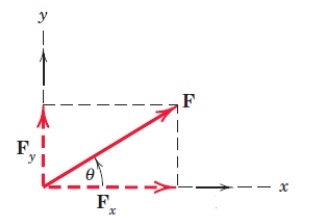
Here, the vector F is resolved into its horizontal component (Fx) and its vertical component (Fy).
How to Calculate the Components
To find the size (magnitude) of each component, we use simple trigonometry. Notice that the vector and its components form a right-angled triangle.
1. The Horizontal (X) Component
The x-component (Fx) is adjacent to the angle θ. Therefore, we use the cosine function.
Fx = F × cos(θ)
2. The Vertical (Y) Component
The y-component (Fy) is opposite to the angle θ. Therefore, we use the sine function.
Fy = F × sin(θ)
Examples
Example 1: The Flower Cart
A child, Ababa, is pulling a cart full of flowers for a festival. She pulls the handle with a force of 50 Newtons at an angle of 30° above the horizontal ground. What is the force that pulls the cart forward?
Solution: We need the horizontal component (Fx) because that’s the force moving the cart forward.
Fx = F × cos(θ)
Fx = 50 N × cos(30°)
Fx = 50 N × 0.866
Fx ≈ 43.3 N
So, 43.3 Newtons of his effort actually moves the cart forward.
Example 2: A Football Kick in a Stadium
During a match, a player kicks a ball with an initial velocity of 25 m/s at an angle of 60°. What is the initial upward velocity of the ball?
Solution: We need the vertical component (Vy) because that’s the upward velocity.
Vy = V × sin(θ)
Vy = 25 m/s × sin(60°)
Vy = 25 m/s × 0.866
Vy ≈ 21.65 m/s
The ball initially moves upwards at 21.65 m/s.
Example 3: Hiking in the Simien Mountains
A hiker walks 500 meters along a steep trail with an incline of 25°. What is her change in altitude (vertical distance gained)?
Solution: The change in altitude is the vertical component of her displacement vector.
Dy = D × sin(θ)
Dy = 500 m × sin(25°)
Dy = 500 m × 0.423
Dy ≈ 211.5 m
She has gained about 211.5 meters in altitude.
Virtual Lab: Vector Explorer
Use this simulation to explore vectors. Drag a vector onto the graph, then click the “Components” button (looks like a graph with a square and triangle) to see its x and y parts change as you move it!
Activity 1: Warm-Up
Activity 2: Check Your Understanding
Activity 3: Calculate the Components
Watch Out! A Common Mistake
Mixing Sine and Cosine
Always pay close attention to which angle is given. Our formulas Fx = F × cos(θ) and Fy = F × sin(θ) work when θ is the angle with the horizontal x-axis.
If a problem gives you the angle with the vertical y-axis (let’s call it angle α), the roles reverse! The component adjacent to that angle (Fy) will use cosine, and the component opposite it (Fx) will use sine.
Fx = F × sin(α)
Fy = F × cos(α)
Look closely at the assessment question about the water bucket from the well—it uses this trick!
Lesson Summary
Vector resolution is the process of breaking a vector into its perpendicular components (usually x and y).
We do this to simplify complex problems by analyzing horizontal and vertical effects separately.
The horizontal component is calculated using: Fx = F × cos(θ).
The vertical component is calculated using: Fy = F × sin(θ).
These components form a right-angled triangle with the original vector as the hypotenuse.
Assessment
Competency Checklist
Check your understanding. Can you do the following?