
Science Seventh grade 9 Sections47 Lessons365 Days
1.1 Plant Cells
Plant Cells
Science Year 7
Lesson Competencies
At the end of the lesson you will be able to:
Identify the main parts of a plant cell.
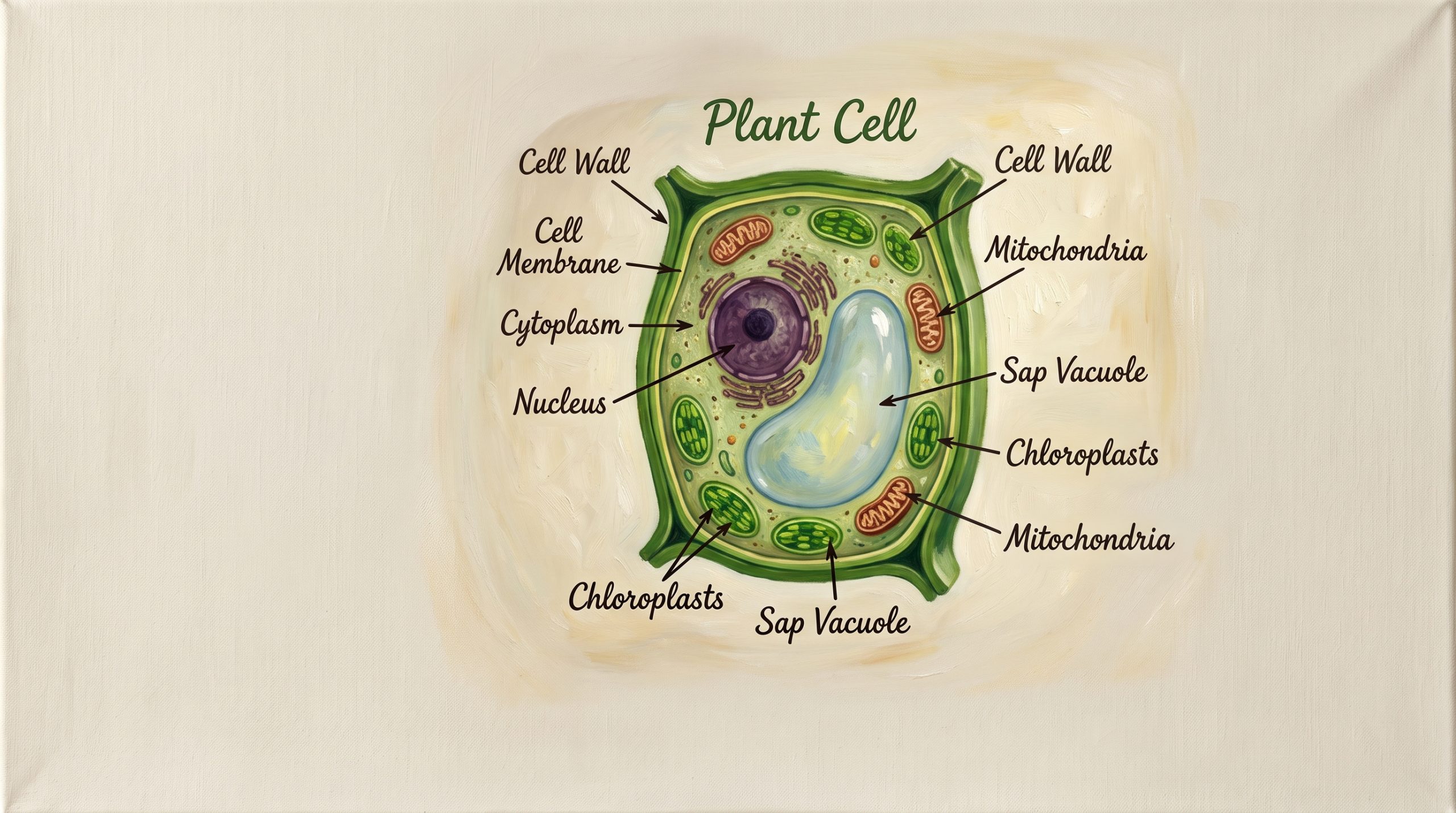
Describe the function of the cell wall, cell membrane, cytoplasm, nucleus, chloroplasts, mitochondria, and sap vacuole.
Explain why plant cells have a cell wall and chloroplasts, while animal cells do not.
Understand the terms chlorophyll, cellulose, and magnify.
Key Terms
Chlorophyll
The green pigment found in chloroplasts that absorbs light energy for making food.
Cellulose
A tough, fibrous material that makes up the sturdy cell wall of plant cells.
Magnify
To make something appear larger than it is, usually using a microscope.
የቪዲዮ ትምህርት
Core Lesson: Inside a Plant Cell
Introduction
Dear learners,
Imagine a giant Oak tree in a park, or a Baobab tree on the African savanna. They stand tall, soaking up the sun, without a skeleton to hold them up or a mouth to eat food! How do they do it? The secret lies in their tiny building blocks: plant cells.
Cells are so small that we must magnify them using a microscope to see them. Just like a factory has different departments, a cell has tiny structures called organelles that each perform a specific job. Today, we will explore the wonderful factory of a plant cell!
The Parts of a Plant Cell
1. Cell Wall (The Sturdy Fence)
Plant cells have a strong outer layer called the cell wall. It is made of a tough material called cellulose. It gives the cell its shape and provides support, allowing plants to stand tall without bones!
2. Cell Membrane (The Security Gate)
Just inside the cell wall is the cell membrane. It acts like a security guard, controlling which substances can enter (like water and nutrients) and exit (like waste) the cell.
3. Cytoplasm (The Factory Floor)
The cytoplasm is a clear, jelly-like substance that fills the cell. All the other organelles float in it, and it’s where most chemical reactions happen.
4. Nucleus (The Control Center)
The nucleus controls all activities of the cell. It contains DNA, the set of instructions that tells the cell what to do and how to grow.
5. Chloroplasts (The Solar Panels)
These green structures are unique to plants. Chloroplasts contain a green pigment called chlorophyll. They absorb sunlight and use it to make food for the plant (sugar) in a process called photosynthesis.
6. Mitochondria (The Power Plants)
Mitochondria take the food made by the chloroplasts and turn it into usable energy for the cell to live and grow.
7. Sap Vacuole (The Storage Tank)
Plant cells have a large, permanent sap vacuole in the center. It stores water, sugars, and waste. When it’s full, it pushes against the cell wall, keeping the plant firm and preventing it from wilting.
Plant vs. Animal Cells
Animals and plants are very different! Because animals eat their food and have skeletons, their cells are built differently.
Animal cells DO NOT have:
- A Cell Wall (animals have skeletons for support instead).
- Chloroplasts (animals eat food, they don’t make it using sunlight).
- A large permanent Sap Vacuole (animal cells only have very small, temporary vacuoles).
Game Time: Uncover the Cell!
Answer the mini-questions to flip the tiles and reveal the hidden microscope image!
Activity: Match the Organelle
How to play: Tap a colored term to select it, then tap the correct dashed box to place it! (Or drag and drop on PC).
Organelles (Tap to select)
Functions (Tap to place)
Activity 1: Knowledge Check
Activity 2: Complete the Sentence
Activity 3: Mixed Challenge
Lesson Summary
Plant Cells are the microscopic building blocks of all plants.
They share some parts with animal cells: a nucleus (control center), cytoplasm (jelly where reactions happen), a cell membrane (gatekeeper), and mitochondria (energy providers).
However, plant cells have three special features that animal cells lack:
- A rigid cell wall made of cellulose for structural support.
- Chloroplasts containing chlorophyll to make food via photosynthesis.
- A large sap vacuole to store water and keep the cell firm.
Final Assessment
Self-Assessment Checklist
Check off the skills you feel confident you have learned today: