
Social Studies 7th grade 13 Sections48 Lessons365 Days
1.3 The movement of the earth
The Movement of the Earth
Social Studies – Grade 7
Lesson Competencies
At the end of the lesson you will be able to:
Define rotation and explain its effects, like day and night.
Define revolution and describe its effects, like the seasons.
Explain how the Earth’s tilt causes the seasons.
Differentiate between rotation and revolution.
Key Terms
Rotation
The spinning of the Earth on its axis, which causes day and night.
Axis
An imaginary line through the center of the Earth from the North Pole to the South Pole.
Revolution
The movement of the Earth in its orbit around the Sun, which takes about one year.
Orbit
The curved path that the Earth follows as it travels around the Sun.
Video Lesson
Core Lesson: Earth’s Great Dance
Dear learners, have you ever wondered why we have day and night, or why the seasons change from the dry season (Bega) to the long rainy season (Kiremt)? It’s not magic! It’s all because of how our planet, Earth, moves through space in two very important ways.
Today, we’ll explore these two movements: the daily spin and the yearly journey. Let’s begin!
1. Earth’s Rotation (The Daily Spin)
Rotation is the spinning of the Earth on its axis. Think of a spinning top; the Earth spins in a similar way. This axis is an imaginary line that runs from the North Pole to the South Pole.
- The Earth completes one full rotation every 24 hours. This is what gives us one full day.
- The Earth rotates from west to east. This is why the Sun appears to rise in the east and set in the west.
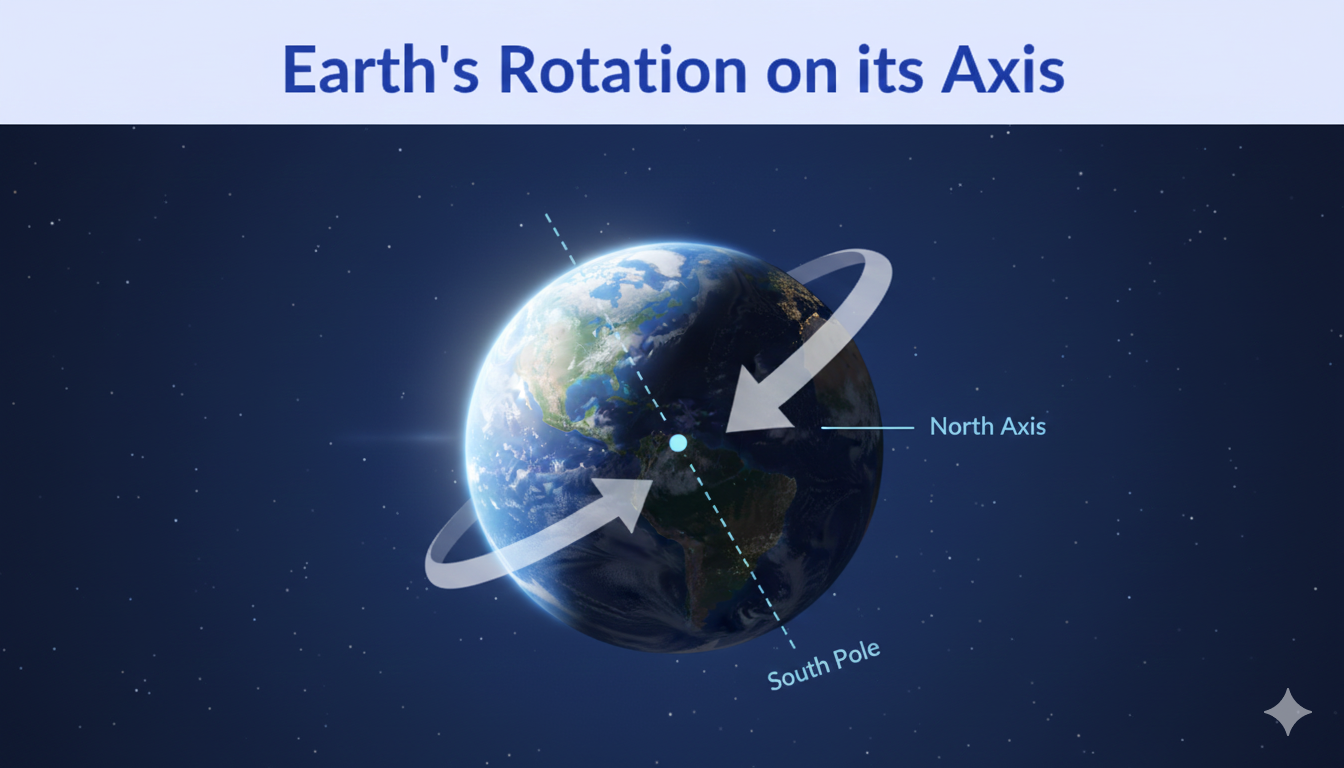
As the Earth rotates, the side facing the Sun experiences day, while the side facing away experiences night.
Effects of Earth’s Rotation:
- Occurrence of Day and Night: This is the most direct effect. As Earth spins, different parts of the planet are exposed to the Sun’s light.
- Apparent Movement of the Sun: The Sun doesn’t actually move across our sky. It appears to because we are spinning.
- Deflection of Winds and Ocean Currents: The spin causes a curving effect on winds and water, known as the Coriolis effect.
2. Earth’s Revolution (The Yearly Journey)
While the Earth is spinning, it is also on a long journey. Revolution is the movement of the Earth in its path, or orbit, around the Sun.
- This journey takes approximately 365.25 days to complete, which we call one year.
- To account for the extra 0.25 day, we add one extra day to the calendar every four years. This is called a leap year.
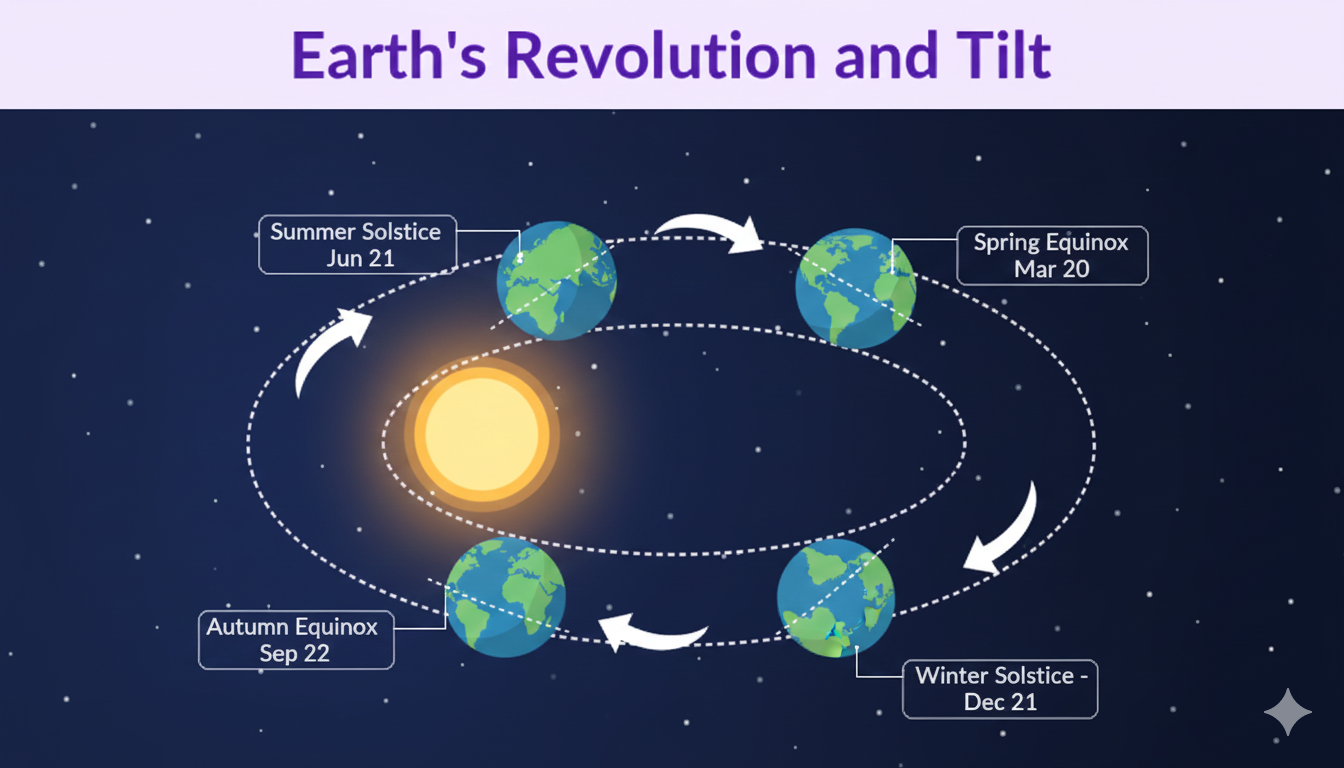
The Earth’s axis is tilted at 23.5 degrees. This tilt, combined with its revolution, causes the seasons.
Effects of Earth’s Revolution:
- The Changing of Seasons: This is the most important effect. Because of the Earth’s 23.5-degree tilt, different parts of the Earth receive more direct sunlight at different times of the year. When the Northern Hemisphere is tilted towards the Sun, it’s summer there. At the same time, it’s winter in the Southern Hemisphere because it’s tilted away.
- Variation in the Length of Day and Night: The tilt also causes the length of daytime and nighttime to change throughout the year. For example, in summer, days are longer, and in winter, they are shorter.
Interactive Lab: Spin & Orbit
Before we test your knowledge, let’s experiment! Use the controls below to simulate how Earth moves. Notice how rotation mimics the day/night cycle, while revolution demonstrates the yearly journey around the Sun.
Activity 1: Check Your Knowledge (MCQ)
Activity 2: True or False?
Activity 3: Mixed Challenge
Lesson Summary
Earth has two main movements: rotation (spinning on its axis) and revolution (orbiting the Sun).
A full rotation takes 24 hours and causes day and night.
A full revolution takes about 365.25 days and, combined with the Earth’s tilt, causes the four seasons.
The Earth’s axis is tilted at an angle of 23.5 degrees, which is the key reason for the seasons.
Final Assessment
Competency Checklist
Check off the skills you’ve mastered in this lesson.