
Biology: Grade 12 8 Sections79 Lessons365 Days
1.4. Applications In Biotechnology
Applications in Biotechnology
Biology Grade 12
Lesson Competencies
At the end of the lesson you will be able to:
Define Biotechnology and explain its significance.
Distinguish between a Transgenic organism and a Transgene.
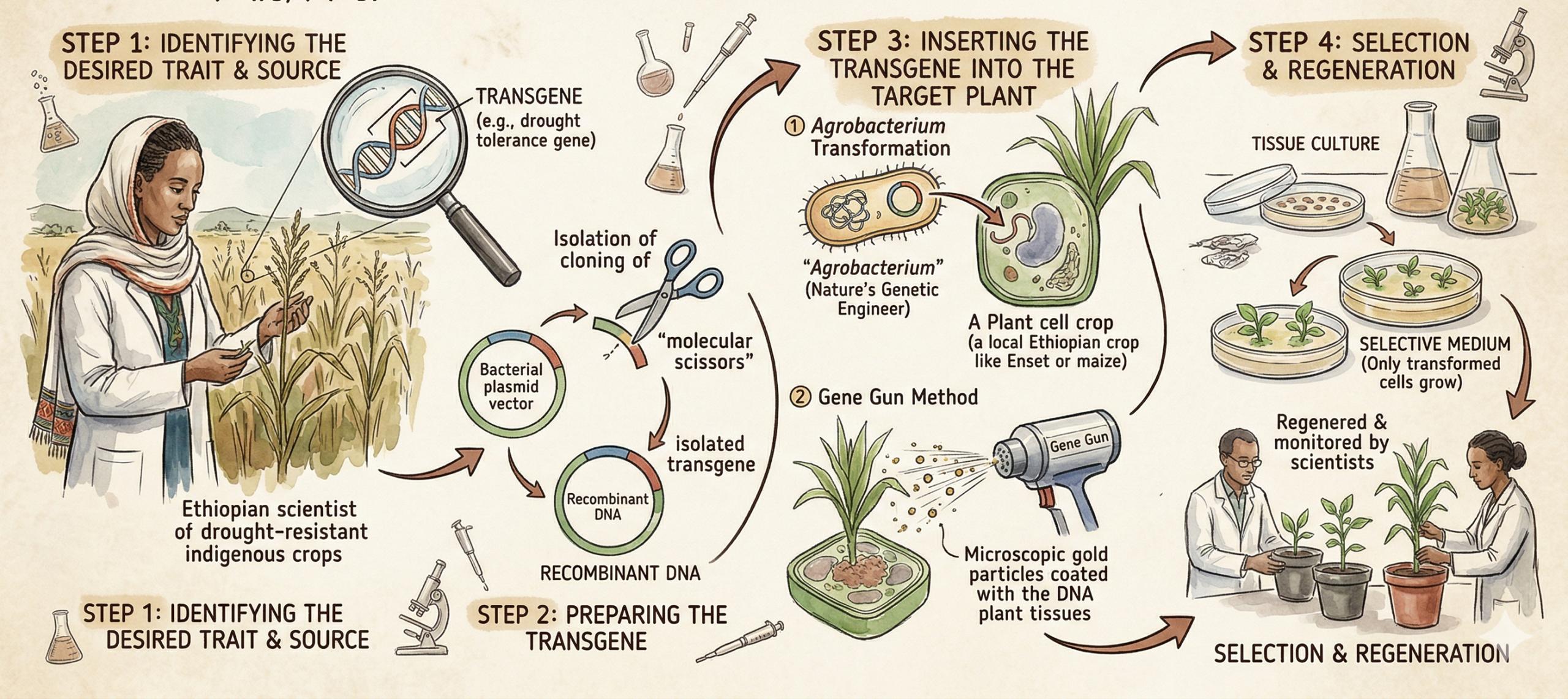
Describe how Recombinant DNA technology creates Genetically modified organisms (GMOs).
Identify the application of biology in agriculture, environmental protection, medicine, and food processing (such as traditional Ethiopian foods).
Key Terms
Biotechnology
The application of technologies involving the use of living organisms, or products from living organisms, for the development of products that benefit humans.
GMOs
Genetically Modified Organisms that have received genetic material via recombinant DNA technology.
Transgenic Organism & Transgene
If an organism receives genetic material from a different species, it is a Transgenic organism. The introduced gene is the Transgene.
Bioremediation
The use of biotechnology in the prevention and mitigation of contamination from industrial, agricultural, and municipal wastes.
Video Lesson
Watch this introduction to modern and traditional biotechnology.
Core Lesson: The Power of Biotechnology
Introduction
Dear learners,
Have you ever wondered how your favorite Enjera gets its spongy texture, or how farmers can grow crops that resist pests without harmful chemicals? The answer lies in Biotechnology!
Scenario: Imagine a farmer in the Oromia region whose tomato crops are frequently destroyed by insects. What if we could give the tomato plant a natural defense mechanism using a gene from another organism? That is the essence of genetic modification!
1. Agriculture & Crops
Organisms are genetically modified to make them more suitable for human needs. Crops like maize or cotton can be modified to increase yields, resist drought, and obtain novel products. When a gene from a different species (a Transgene) is introduced, the crop becomes a Transgenic organism.
2. Environmental Protection
Biotechnology is crucial for the prevention and mitigation of contamination from industrial, agricultural, and municipal wastes. For instance, special bacteria can be used to clean up toxic chemicals from factory effluents near rivers like the Awash river, a process called bioremediation.
3. Diagnosis and Treatment of Disease
In medicine, recombinant DNA technology is used to produce life-saving drugs like synthetic insulin for diabetes patients and vaccines. It allows for faster and more accurate diagnosis of diseases.
4. Food Processing and Production
Application of biology for food processing relies heavily on living organisms (like yeast and bacteria). This includes:
- Bread making: The fermentation of Teff dough using natural yeast for Enjera, or yeast in Defo Dabo.
- Dairy Products: Bacteria ferment milk to produce Ergo (fermented milk) and Ayib (cottage cheese).
- Fermented Meats: Creating preserved meats using bacterial cultures.
- Beverages: Production of beer (like traditional Tella), wine (like Tej), and spirits through yeast fermentation.
Illustration: Recombinant DNA
Educational Game: Biotech Factory Match
Instructions: Drag the biotechnology examples (or TAP to select, then TAP a bucket) to sort them into the correct application category!
Examples to Sort
Application Categories
Agriculture
Medicine
Environment
Food Processing
Activity 1: Knowledge Check
1 / 5Activity 2: True or False
1 / 5Activity 3: Mixed Challenge
1 / 5Lesson Summary
Biotechnology utilizes living organisms or their products to create beneficial products for humans.
Through Recombinant DNA technology, an organism that receives a Transgene (foreign gene) becomes a Genetically modified organism (GMO) or a Transgenic organism.
Applications span across multiple sectors:
- Agriculture: Enhancing crop yield and resistance.
- Environment: Using bioremediation to mitigate waste contamination.
- Medicine: Diagnosing and treating diseases (e.g., insulin production).
- Food Processing: Producing bread, dairy (Ergo, Ayib), fermented meats, and beverages (Tella, Tej) using microbes.
Final Assessment
1 / 5Competency Checklist
Can you confidently say you have achieved the following?