
Science: 7th grade 11 Sections54 Lessons365 Days
1.1 Definition of Science and its Branches
Definition of Science and its Branches
General Science – Grade 7
Lesson Competencies
At the end of the lesson you will be able to:
Key Terms
Scientia
Latin word meaning “Knowledge”. The root word for Science.
Indigenous Science
Knowledge built by local people based on social, physical, and spiritual understanding of their environment.
Conventional Science
System of knowledge relying on established laws and the scientific method (Western science).
Branches
Divisions of science, mainly Natural Science (Physics, Chemistry, Biology) and Social Science.
Video Lesson
Core Lesson
Introduction
Dear learners, in lower grades, you learned about science in general, like environmental science. In Grade 7, you will start learning General Science, which deals with things related to your day-to-day life.
Brainstorming Activity 1.1
Form a group or think individually:
- Describe science in your own words.
- How is science divided?
- What is the difference between Conventional and Indigenous Science?
What is Science?
The word science comes from the Latin word ‘Scientia‘, which means ‘Knowledge‘. But science is not just about having knowledge.
Science is a systematic method of gaining knowledge about the physical and natural world based on observation and evidence.
Types of Science
Indigenous Science
This is the process by which indigenous people build empirical knowledge of their natural environment. It is based on social, physical, and spiritual understandings.
- Using Hagenia Abyssinica (Kosso) to treat tapeworm.
- Using Eucalyptus (Bahrzaf) and Damakese for colds.
- Preserving meat by adding salt and smoke drying.
Conventional Science
Also known as Western science. It relies on certain laws established through the application of the scientific method to phenomena in the world around us.
- Standardized units.
- Universal laws.
- Formal experimentation.
Why learn Indigenous Knowledge? To increase awareness of culture and integrate it with western science.
Branches of Science
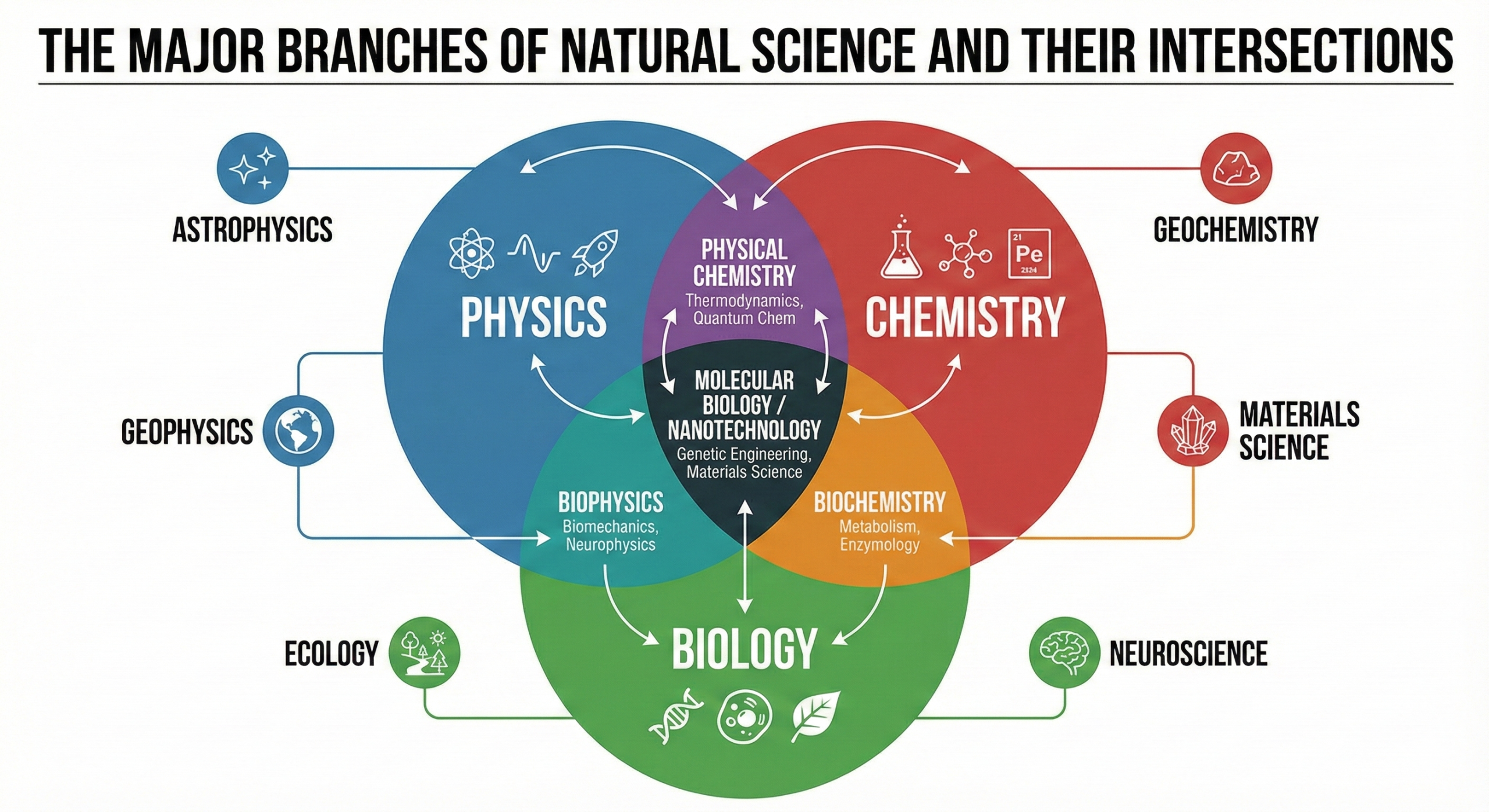
Science is broadly categorized into Natural Science (study of nature) and Social Science (study of society). In General Science, we focus on Natural Science.
Biology
Studies living things.
Chemistry
Studies substances, composition, and transformation.
Physics
Studies matter, energy, and their interactions.
Note: There is no clear border. They overlap!
- Biophysics: Biology + Physics (Physical processes in living things).
- Biochemistry: Biology + Chemistry (Chemical processes in living things).
Interactive Activity: Science Sorter
Mini Game
Test your speed! Sort the incoming terms into their correct scientific branch before the timer runs out.
Science Sorter
Read the term in the center and click the correct scientific branch before time runs out! Incorrect answers subtract time.
Activity 1: Check Your Basics Multiple Choice
Activity 2: True or False 5 Questions
Activity 3: Match the Branch
Drag the definition or example to the correct Branch of Science.
Definitions Bank
Lesson Summary
Science comes from the Latin ‘Scientia’ (Knowledge) and is a systematic way of learning through observation and evidence.
Indigenous Science is local knowledge (e.g., herbal medicine like Kosso), while Conventional Science is international and law-based.
The main branches of Natural Science are Biology (Life), Chemistry (Substances), and Physics (Energy/Matter).
These branches overlap to form fields like Biophysics and Biochemistry.
Final Assessment
Quiz Complete!
You scored out of 5
Competency Check
I can…