
Maths: Year 6 17 Sections37 Lessons10 Weeks
10.2 Division
Division
Math Year 6 Cambridge Curriculum
Lesson Competencies
At the end of the lesson you will be able to:
Estimate the size of an answer before calculating it.
Divide whole numbers up to 1000 by 1-digit whole numbers.
Divide whole numbers up to 1000 by 2-digit whole numbers.
Identify and use terms like dividend, divisor, quotient, and remainder.
Key Terms
Dividend
The number that is being divided. It is usually the largest number in the equation.
Divisor
The number by which another number is to be divided.
Quotient
The answer you get after dividing one number by another.
Remainder
The amount left over after division when one number does not divide evenly into another.
Video Lesson
Core Lesson: Mastering Division
Introduction
Dear learners,
Imagine you are helping a farmer in Ethiopia’s beautiful Kaffa region. He has just harvested exactly 850 kilograms of fresh coffee beans. He wants to share his harvest equally into 5 large sacks to transport them to the market in Addis Ababa.
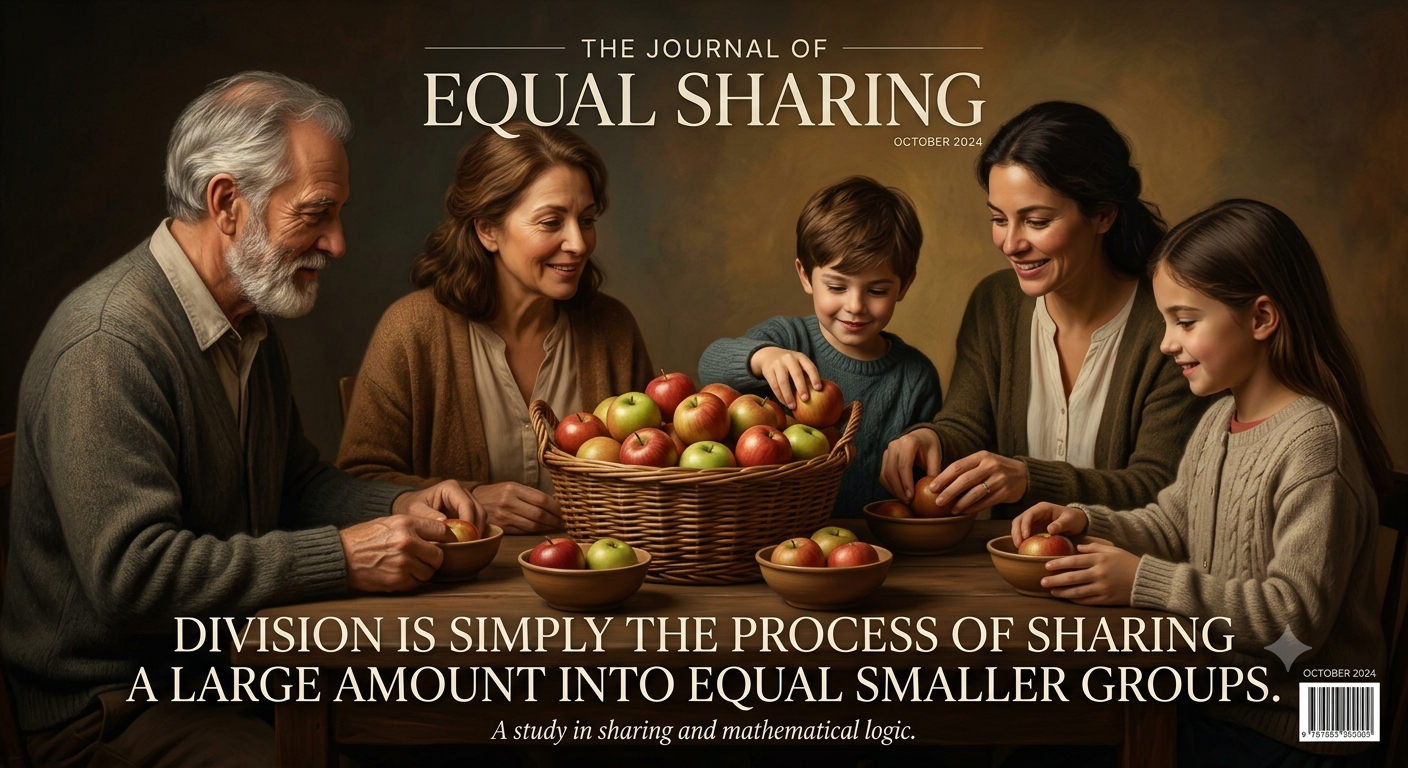
To find out how many kilograms go into each sack, we use division! Division is all about sharing or grouping items equally.
The Parts of Division
In our coffee bean story: \( 850 \div 5 = 170 \)
- 850 is the Dividend (total coffee beans).
- 5 is the Divisor (number of sacks).
- 170 is the Quotient (kilograms in each sack).
1. Estimating First
Before calculating the exact answer, it’s smart to estimate. This gives you an idea of what size your answer should be.
Example: Estimate \( 784 \div 8 \)
1. Round 784 to a friendly number close to it that easily divides by 8. Let’s use 800.
2. Calculate \( 800 \div 8 = 100 \).
3. Since 784 is slightly less than 800, our real answer will be slightly less than 100.
2. Dividing by a 1-Digit Number
Let’s solve the farmer’s problem exactly: \( 850 \div 5 \)
1 7 0 ← Quotient
_____
5 | 8 5 0 ← Dividend
– 5 (5 goes into 8 one time. 8-5=3)
—
3 5 (Bring down the 5)
– 3 5 (5 goes into 35 seven times. 35-35=0)
—
0 0 (Bring down the 0. 5 goes into 0 zero times)
3. Dividing by a 2-Digit Number
Now, let’s look internationally. A famous bakery in Paris baked 972 macarons. They pack them into beautiful boxes of 12.
How many boxes will they fill? We need to calculate \( 972 \div 12 \).
Steps to solve \( 972 \div 12 \):
- Look at the first two digits of the dividend (97). How many times does 12 go into 97?
- We know \( 12 \times 8 = 96 \). So it goes in 8 times. Write 8 above the 7.
- Subtract: \( 97 – 96 = 1 \).
- Bring down the 2, making it 12.
- How many times does 12 go into 12? Exactly 1 time. Write 1 above the 2.
- The final quotient is 81 boxes, with a remainder of 0.
Visualizing Division
How to play: Tap a number or term below to select it (it will highlight), then tap an empty box in the equation below to place it there. Build a correct division equation!
Number & Term Bank
Build the Relationship
Activity 1: Division Check
Question 1 of 5Activity 2: Calculate & Type
Question 1 of 5Lesson Summary
Estimation helps predict the answer before calculating.
The Dividend is shared by the Divisor to find the Quotient.
Any amount left over that cannot be evenly shared is the Remainder.
When dividing up to 1000 by 2-digit numbers, look at the first two digits of the dividend first.